
Shockwave Therapy vs. PRP for Plantar Fasciitis: What’s the Difference?
Persistent heel pain can make walking, exercising, and standing throughout the day difficult. When plantar fasciitis does not improve with conservative care, patients may consider advanced options such as shockwave therapy and platelet-rich plasma (PRP) injections.
Both treatments may help selected patients, but they work differently. Shockwave therapy uses acoustic waves without an injection, while PRP involves injecting concentrated platelets obtained from the patient’s own blood. Current research supports considering both approaches, but neither is guaranteed to work for everyone.
At Flex Foot & Ankle, patients can explore personalized plantar fasciitis treatment options with Dr. E. Giannin Perez, DPM, FACFAS, in Midtown Manhattan.
What Is Plantar Fasciitis?
The plantar fascia is a thick band of connective tissue that runs along the bottom of the foot, supporting the arch and connecting the heel area toward the toes. Repetitive strain on this tissue can cause pain near the heel.
Common symptoms include:
- Heel pain during the first steps in the morning
- Discomfort after sitting or resting
- Pain that worsens after prolonged standing or walking
- Tenderness along the bottom of the heel
Because other conditions can also cause heel pain, an accurate diagnosis is important before choosing a treatment. Learn more about our heel pain treatment options.
Shockwave Therapy vs. PRP: How Do They Compare?
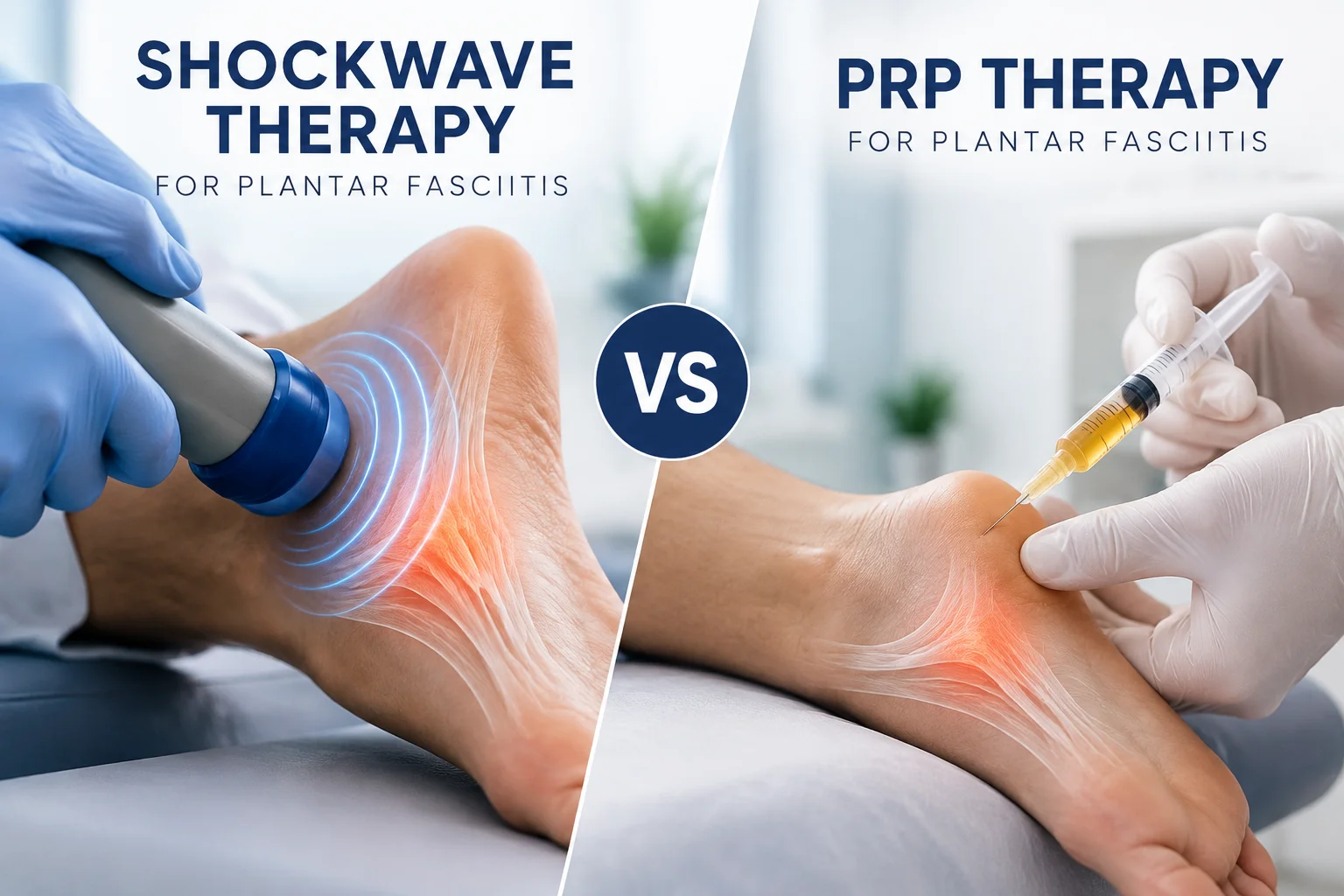
The main difference is how each treatment is delivered. Shockwave therapy applies acoustic waves to the affected area, while PRP uses a concentrated preparation of the patient’s own platelets injected into the targeted tissue.
| Comparison | Shockwave Therapy (ESWT) | PRP Injections |
|---|---|---|
| How it works | Delivers acoustic waves to the painful area to stimulate a tissue response | Uses concentrated platelets prepared from the patient’s blood |
| Procedure | An external device is applied to the treatment area | Blood is drawn, processed, and injected into the targeted tissue |
| Invasiveness | Non-invasive; no injection is required | Minimally invasive; involves a needle |
| Treatment schedule | Often involves a series of sessions | The number of injections and follow-ups depends on the treatment plan |
| Possible discomfort | Temporary discomfort during or after treatment | Temporary soreness or swelling following the injection |
| Evidence | Research supports potential benefits, although outcomes vary | Research shows potential benefits, but results and protocols vary |
| Best choice | Depends on the diagnosis, symptoms, medical history, and treatment goals | Depends on the diagnosis, symptoms, medical history, and treatment goals |
Neither option should be selected based on the treatment name alone. A podiatric evaluation helps determine whether either approach is appropriate for the individual patient.
How Does Shockwave Therapy Work for Plantar Fasciitis?
Extracorporeal shockwave therapy (ESWT) delivers acoustic waves through the skin to the affected area. It does not require an injection or surgical incision.
A clinician applies a treatment device to the heel, directing the waves toward the targeted tissue. The intensity and treatment schedule depend on the device, clinical protocol, and patient’s condition.
Shockwave therapy may be considered when heel pain persists despite initial conservative treatment. It is generally used as part of a broader treatment plan rather than a guaranteed standalone solution.
Potential advantages include:
- No injection or surgical incision
- A non-invasive treatment approach
- The ability to target the painful area
- A potential option for persistent plantar fasciitis
Some patients experience discomfort during treatment or temporary soreness afterward. Suitability must be assessed individually, particularly when medical conditions or medications could affect treatment safety.
Read more about Shockwave Therapy at Flex Foot & Ankle.
How Do PRP Injections Work for Plantar Fasciitis?
Platelet-rich plasma (PRP) is prepared from a sample of the patient’s own blood. The sample is processed to concentrate platelets in the plasma before the preparation is injected into the targeted tissue.
Platelets contain growth factors involved in the body’s healing processes. PRP is intended to support the tissue’s healing response, although its effectiveness varies between patients and conditions.
The procedure typically involves:
- Collecting a blood sample.
- Processing the sample to concentrate platelets.
- Injecting the PRP into the selected treatment area.
- Following an individualized aftercare and monitoring plan.
PRP may be discussed for persistent plantar fasciitis when a clinician considers an injection-based approach appropriate. It is not a guaranteed cure, and some patients experience temporary pain or swelling after the procedure.
PRP preparation methods differ between clinical protocols, which is one reason research findings are not always consistent.
Explore PRP Therapy at Flex Foot & Ankle.
What Does Medical Research Say About Shockwave Therapy vs. PRP?
Research provides useful comparisons, but the findings should be interpreted carefully because studies differ in treatment protocols, follow-up periods, and outcome measurements.
A 2024 systematic review and meta-analysis published in Foot & Ankle International examined six randomized controlled trials involving 432 participants. PRP showed statistically greater improvements in pain scores and plantar fascia thickness at three to six months. However, the authors concluded that the difference in pain reduction did not reach clinical significance.
A separate 2025 systematic review in Foot and Ankle Surgery included 15 studies involving 1,123 patients. It found evidence supporting shockwave therapy compared with placebo and reported favorable results for PRP on certain post-treatment pain and functional measures.
More recently, a 2026 network meta-analysis in Scientific Reports examined 63 randomized controlled trials involving 4,170 participants. The findings supported the effectiveness of shockwave therapy across several outcomes, while PRP showed benefits for longer-term function and plantar fascia thickness. The certainty of evidence varied by treatment comparison and outcome.
These studies do not establish one universally superior treatment. Instead, they suggest that the choice between shockwave therapy and PRP should account for the patient’s symptoms, treatment history, goals, and the limitations of the available evidence.
Sources:
- 2024 PRP vs. Shockwave Therapy Meta-analysis — PubMed
- 2025 Shockwave Therapy Systematic Review and Meta-analysis — PubMed
- 2026 Comparative Effectiveness Network Meta-analysis — Scientific Reports
Should You Try Conservative Treatment First?
Advanced treatments are not automatically the first step for plantar fasciitis. Many patients improve with conservative management, although recovery time varies.
Depending on the clinical assessment, treatment may include:
- Plantar fascia and calf stretching
- Activity modification
- Supportive footwear
- Physical therapy and targeted exercises
- Taping or other supportive measures
- Custom orthotics when appropriate
The 2023 clinical practice guideline published in the Journal of Orthopaedic & Sports Physical Therapy supports several conservative interventions, including plantar fascia-specific stretching and calf stretching.
If additional support is appropriate, learn about Custom Orthotics at Flex Foot & Ankle.
Shockwave therapy or PRP may be considered when symptoms persist and the clinician determines that further treatment is warranted.
Which Treatment May Be Right for You?
There is no single answer for every patient. The decision should follow an evaluation of the condition and the treatments already attempted.
Shockwave therapy may be worth discussing if:
- Your heel pain persists despite initial treatment.
- You prefer to explore a non-injection option.
- You can attend the recommended treatment sessions.
PRP may be worth discussing if:
- Your symptoms persist and an injection-based approach is being considered.
- Your clinician believes PRP is appropriate for your diagnosis.
- You understand the potential benefits, limitations, and recovery considerations.
The clinician should also consider your medical history, medications, activity level, and treatment preferences. Cost and insurance coverage may vary, so these details should be confirmed before proceeding.
Neither treatment guarantees pain relief, and both require realistic expectations.
Personalized Plantar Fasciitis Care in Manhattan
At Flex Foot & Ankle, Dr. E. Giannin Perez, DPM, FACFAS, evaluates foot and ankle conditions and discusses treatment options based on each patient’s symptoms, health history, and goals.
Located at 1410 Broadway, Suite 1102, between 38th and 39th Street, New York, NY 10018, the practice offers plantar fasciitis treatment, shockwave therapy, and PRP injections.
Dr. Perez also provides consultations in English and Spanish, helping patients communicate comfortably about their symptoms and treatment options.
If persistent heel pain is affecting your daily activities, a professional evaluation can help clarify the diagnosis and determine which options may be appropriate.
Frequently Asked Questions
Is shockwave therapy better than PRP for plantar fasciitis?
Neither treatment is universally better. Research reports different results depending on the outcome measured, follow-up period, and treatment protocol. The most appropriate option depends on the patient’s condition and clinical evaluation.
Is shockwave therapy painful?
Some patients experience discomfort during treatment or temporary soreness afterward. The experience varies with the treatment settings and individual sensitivity. Your clinician can explain what to expect before starting.
How long does PRP take to work for plantar fasciitis?
There is no fixed timeline. Some patients notice changes over several weeks, while improvement may take months or may not occur. Results vary, and follow-up is important to assess the response.
How many shockwave therapy sessions are needed?
The number of sessions depends on the clinical protocol, device, symptoms, and response to treatment. Your clinician can explain the recommended schedule after evaluating your condition.
Can shockwave therapy and PRP be used together?
A clinician may consider different treatment approaches as part of an individualized plan, but combining them is not automatically necessary and does not guarantee better results. The appropriate sequence, if any, depends on the clinical assessment.
Should I try shockwave therapy or PRP before other plantar fasciitis treatments?
Not necessarily. Conservative options such as stretching, supportive footwear, activity modification, and appropriate physical therapy are commonly used first. Additional treatments may be considered if symptoms persist.
When should I see a podiatrist for heel pain?
Consider an evaluation if heel pain persists, returns frequently, or interferes with walking or exercise. Seek prompt medical assessment for severe or sudden pain, an inability to bear weight, or symptoms accompanied by significant swelling, redness, fever, or a recent injury.
References and Further Reading
- Mayo Clinic — Plantar Fasciitis: Diagnosis and Treatment
- American Physical Therapy Association — Heel Pain and Plantar Fasciitis Clinical Practice Guideline, 2023
- Daher et al. — PRP vs. Extracorporeal Shockwave Therapy, 2024
- Tung et al. — Shockwave Therapy Compared With Other Treatments, 2025
- Tien et al. — Comparative Effectiveness of Minimally Invasive Therapies, 2026
- Cleveland Clinic — Platelet-Rich Plasma (PRP Injection)
This article is published by Flex Foot & Ankle for educational purposes and does not replace an individualized medical evaluation. Treatment benefits, risks, and suitability vary by patient.

