
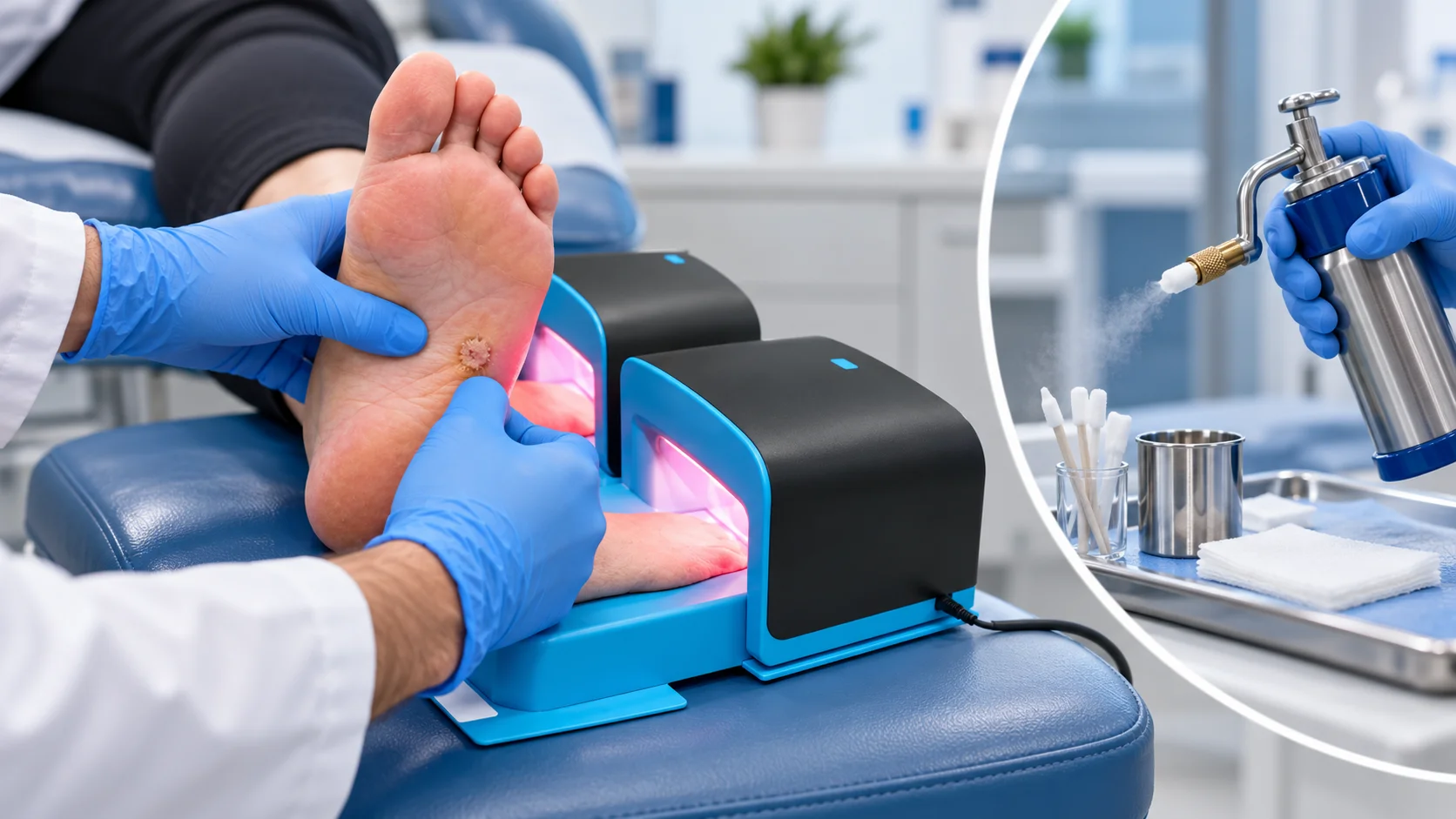
Swift System vs. Cryotherapy and Other Plantar Wart Treatments: What Does the Evidence Say?
Plantar warts can become painful, persistent, and frustrating to treat, especially when they develop on weight-bearing areas of the foot. Although some warts resolve without treatment, others remain for months or return after treatment.
Patients exploring plantar wart treatment options may encounter several approaches, including salicylic acid, cryotherapy, and newer technologies such as the Swift System.
But how do these treatments differ, and what does the medical evidence actually show?
At Flex Foot & Ankle in Manhattan, NY, Dr. E. Giannin Perez, DPM, FACFAS, offers professional evaluation and treatment options for plantar warts, including advanced Swift microwave therapy. Understanding the differences between available treatments can help patients make informed decisions about their foot health.
What Are Plantar Warts?
Plantar warts, also called verrucae, are growths on the soles of the feet caused by certain types of human papillomavirus (HPV). The virus can enter the skin through small cuts, cracks, or other openings.
Because plantar warts often develop on the heel or ball of the foot, the pressure created by standing and walking can make them uncomfortable.
Common signs include:
- A rough, thickened growth on the sole of the foot
- Small dark dots within the lesion
- Pain or tenderness when walking or standing
- Disruption of the normal lines of the skin
- One wart or multiple lesions clustered together
Plantar warts can resemble corns or calluses. An accurate diagnosis matters because these conditions require different approaches to treatment.
If you are unsure what is causing a painful spot on your foot, a podiatric evaluation can help determine the appropriate next step. Learn more about Plantar Warts Treatment in Manhattan.
Why Can Plantar Warts Be Difficult to Treat?
The immune system can sometimes eliminate the virus responsible for a plantar wart without medical intervention. However, this process may take months or longer, and not every wart resolves spontaneously.
Treatment can also be challenging because plantar warts may have thickened skin over the affected tissue and are exposed to repeated pressure during daily activities.
Some patients improve with topical treatments, while others experience persistent symptoms despite multiple attempts.
There is no single treatment that guarantees clearance for every patient. The most appropriate approach depends on the lesion, its duration, previous treatments, symptoms, and the patient’s overall health.
Swift System for Plantar Warts: An Advanced Treatment Option
The Swift System is a medical device that uses controlled microwave energy to treat common and plantar warts. Unlike cryotherapy, it does not rely on freezing the lesion with liquid nitrogen.
The treatment delivers microwave energy to the affected tissue through a specialized applicator. The proposed mechanism involves a localized tissue response that may help the immune system recognize and respond to HPV-infected tissue. The precise biological mechanisms are not yet fully understood.
Swift is a non-invasive, office-based approach that does not require cutting out the wart.
Potential advantages of Swift therapy
Depending on the patient’s condition and treatment goals, potential advantages include:
- No surgical incision to remove the wart
- A treatment approach that differs from freezing or topical medication
- No routine requirement for an open surgical wound
- An option to discuss when plantar warts persist or return after previous treatments
Swift is not necessarily the right choice for every patient, and it should not be described as painless or guaranteed to eliminate a wart. Treatment may cause discomfort, and local side effects can occur.
The Swift System received FDA clearance for the treatment of common and plantar warts in August 2025. This regulatory clearance supports its specified use, but it does not establish that Swift is superior to every alternative.
At Flex Foot & Ankle, patients can learn more about the technology through our Swift System for Warts treatment page.
How Does Cryotherapy Work?
Cryotherapy is an established treatment that uses extreme cold, commonly liquid nitrogen, to destroy wart tissue.
During treatment, a clinician applies the freezing agent to the lesion. The procedure damages the affected tissue, which subsequently heals as the treated area recovers.
Cryotherapy is widely used for plantar warts, although several sessions may be needed.
Potential advantages of cryotherapy
- An established treatment approach
- Availability in many clinical settings
- A direct method of treating visible wart tissue
- The possibility of combining treatment with other approaches when appropriate
Limitations and possible side effects
Cryotherapy may cause pain, blistering, swelling, or temporary changes in skin pigmentation. Repeated sessions may be necessary, and some plantar warts do not respond adequately.
The American Academy of Dermatology explains that cryotherapy is a common in-office treatment for plantar warts, but multiple sessions may be required.
The number of treatments depends on the lesion and the clinician’s protocol.
Swift System vs. Cryotherapy: Key Differences
Although both treatments can be used for plantar warts, their methods and treatment experiences differ.
| Feature | Swift System | Cryotherapy |
|---|---|---|
| Technology | Controlled microwave energy | Extreme cold, commonly liquid nitrogen |
| Treatment approach | Delivers energy to the affected tissue without an incision | Freezes and damages wart tissue |
| Office procedure | Yes | Yes |
| Possible discomfort | Heat, pain, or temporary tenderness | Pain, stinging, or tenderness |
| Possible local effects | Pain, blistering, itching, altered sensation, or discoloration | Pain, blistering, swelling, or pigment changes |
| Treatment schedule | Depends on the clinical protocol and response | Often requires repeated sessions |
| Evidence | Includes observational studies and randomized trials; further research is needed | Established treatment supported by clinical guidance |
| Best choice | Depends on the patient’s condition and clinical assessment | Depends on the patient’s condition and clinical assessment |
Neither option is automatically the best treatment for every plantar wart. The comparison should consider the patient’s medical history, previous treatment results, preferences, and the available evidence.
What About Salicylic Acid and Other Treatments?
Swift and cryotherapy are not the only options. Several other treatments may be appropriate depending on the wart and the patient’s circumstances.
Salicylic acid
Salicylic acid is a topical treatment that gradually removes layers of affected skin. It is commonly used for warts and may be available in over-the-counter preparations.
Treatment generally requires consistent application over an extended period. Skin irritation can occur, particularly if the medication affects healthy surrounding skin.
People with diabetes, peripheral neuropathy, or poor circulation should seek professional guidance before using salicylic acid on their feet.
The American Academy of Dermatology provides additional guidance on wart treatment and at-home care.
Other in-office procedures
For selected persistent or difficult-to-treat warts, a clinician may consider additional approaches, such as prescription topical medications, laser treatment, immunotherapy, or procedures that remove or destroy wart tissue.
These options differ in availability, evidence, recovery requirements, and potential side effects. Some procedures can cause bleeding, discomfort, or scarring.
The decision should be based on an appropriate evaluation rather than assuming that a more invasive procedure will necessarily be more effective.
What Does the Medical Evidence Say About Swift?
A useful treatment comparison should consider clinical studies rather than relying solely on promotional claims.
The evidence for microwave therapy is promising, but it remains important to distinguish early results from definitive proof of superiority.
1. FDA clinical study comparing Swift with cryotherapy
The FDA’s 2025 clearance documentation includes a randomized, multicenter clinical study comparing Swift with cryotherapy.
The study randomized 119 participants to the two treatment groups. However, only 93 participants had evaluable data for the primary effectiveness analysis at three months.
In the overall evaluable population, which included both common and plantar warts, clearance rates were 38.8% with Swift and 38.6% with cryotherapy.
The study did not conclusively establish non-inferiority or superiority for its primary endpoint because of the missing follow-up data.
In the plantar wart subgroup, clearance was 48.0% with Swift and 36.4% with cryotherapy. This subgroup result should be interpreted cautiously and does not establish that Swift is definitively superior.
The study also recorded fewer adverse events overall in the Swift group than in the cryotherapy group. However, the sample size and study limitations mean that individual outcomes may differ.
Read the FDA’s official Swift System clearance documentation.
2. Randomized placebo-controlled study published in 2025
A separate randomized, placebo-controlled trial examined microwave therapy for resistant plantar warts in adults.
Of the 32 participants initially enrolled, 28 remained in the final analysis. Complete clearance occurred in 27.3% of the analyzed treatment group, compared with none of the placebo group. Partial improvement was also reported.
The researchers concluded that microwave therapy performed better than the placebo procedure in this small study. They also emphasized the need for larger studies and optimized treatment protocols.
These findings support continued investigation of Swift, particularly for persistent plantar warts, but they do not establish a guaranteed success rate.
Read the 2025 randomized clinical trial on PubMed.
3. Earlier observational research
A 2023 retrospective study reviewed 85 patients who received microwave treatment for plantar warts at a U.S. podiatry center.
Complete clearance was documented in 60% of the original patient group. Among the 59 patients who completed treatment, the reported clearance rate was 86.4%.
However, 26 patients were lost to follow-up, which limits how confidently the results can be generalized to all patients.
Observational studies can provide useful real-world information, but their results should not be interpreted in the same way as those of a randomized controlled trial.
Read the 2023 study in the Journal of Cosmetic Dermatology.
What can patients conclude?
Taken together, the available research supports Swift as a legitimate treatment option for plantar warts. However, study designs, protocols, follow-up periods, and results vary.
The evidence does not justify claiming that Swift is always more effective than cryotherapy or other treatments.
A clinician can help determine whether Swift, cryotherapy, salicylic acid, or another approach is appropriate for an individual patient.
Who May Benefit From a Professional Plantar Wart Evaluation?
An evaluation may be particularly helpful if you have:
- A plantar wart that has persisted despite previous treatment
- A lesion that repeatedly returns
- Pain that interferes with walking or exercise
- Multiple plantar warts
- Uncertainty about whether the lesion is a wart, corn, or callus
People with diabetes, reduced sensation, poor circulation, or weakened immune systems should seek individualized medical guidance rather than attempting potentially damaging home treatments.
A lesion that bleeds, changes in appearance, becomes increasingly painful, or does not respond as expected should also be assessed by a qualified clinician.
Advanced Swift Treatment at Flex Foot & Ankle in Manhattan
At Flex Foot & Ankle, patients can explore modern treatment options for persistent and painful plantar warts, including the Swift System.
Dr. E. Giannin Perez, DPM, FACFAS, provides foot and ankle care in Midtown Manhattan. Her approach emphasizes evaluating the condition, reviewing previous treatments, and discussing suitable options based on each patient’s needs.
The practice offers:
- Swift microwave therapy for selected plantar warts
- Professional evaluation of painful or persistent lesions
- Personalized discussion of available treatment options
- Care focused on comfort, function, and appropriate follow-up
- Consultations in English and Spanish
The clinic is located at 1410 Broadway, Suite 1102, between 38th and 39th Street, New York, NY 10018.
If you are looking for plantar wart treatment in Manhattan, a consultation can help establish whether the lesion is a plantar wart and whether Swift or another treatment is appropriate.
Explore our Plantar Warts Treatment in Manhattan page or learn more about the Swift System for Warts.
Frequently Asked Questions About Swift and Plantar Warts
Is Swift more effective than cryotherapy for plantar warts?
Current evidence does not establish that Swift is universally more effective than cryotherapy. A 2025 FDA clinical study reported similar overall clearance rates in its evaluable population, while its plantar wart subgroup showed numerically higher clearance with Swift. The study’s primary endpoint was inconclusive, so these findings should be interpreted cautiously.
Is the Swift System FDA-approved for plantar warts?
The Swift System received FDA 510(k) clearance for the treatment of common and plantar warts in August 2025. FDA clearance is not the same regulatory process as FDA approval, and it does not guarantee an individual treatment outcome.
Does Swift treatment hurt?
Patients may experience heat, discomfort, or pain during treatment, and temporary local side effects can occur. Swift should not be described as completely painless. Your clinician can explain what to expect and discuss your concerns before treatment.
How many Swift treatments are needed?
The number of sessions varies with the clinical protocol, wart characteristics, and treatment response. Studies have used different schedules, so a single number should not be presented as appropriate for everyone. Your clinician can discuss a suitable plan after evaluating the wart.
Can plantar warts return after Swift treatment?
Yes. No treatment guarantees that a plantar wart will never return. HPV-related lesions can persist or recur, and follow-up may be needed to evaluate the response and determine whether further treatment is appropriate.
Can I treat plantar warts at home instead?
Some patients may benefit from topical salicylic acid or other recommended home treatments. However, the diagnosis should be correct, and treatment must be used as directed. People with diabetes, neuropathy, or poor circulation should consult a healthcare professional before using wart-removal products on their feet.
When should I see a podiatrist for plantar warts?
Consider an appointment if the lesion is painful, persistent, recurrent, or interfering with walking. Seek prompt medical assessment if it bleeds, changes in appearance, or you are unsure of the diagnosis. People with diabetes or impaired circulation should obtain individualized medical guidance.
Medical References
- U.S. Food and Drug Administration (FDA). Swift System and swiftPro System, 510(k) clearance documentation, K250718, August 2025. Official FDA document.
- Haase O, et al. Microwave therapy for the treatment of resistant plantar warts: a randomized, placebo-controlled clinical trial. Archives of Dermatological Research, 2025. PubMed.
- Gupta AK, et al. The treatment of plantar warts using microwave—A review of 85 consecutive cases in the United States. Journal of Cosmetic Dermatology, 2023. PubMed.
- American Academy of Dermatology (AAD). Warts: Diagnosis and treatment. Clinical and patient guidance.
- American Academy of Dermatology (AAD). Warts: Dermatologists’ tips for at-home treatment. Home treatment guidance.
- Mayo Clinic. Plantar warts: Symptoms and causes. Medical reference.
This article is intended for educational purposes and does not replace professional medical advice, diagnosis, or treatment. Treatment decisions should be made with a qualified healthcare professional after an individual evaluation.

